
Anúncios
Modern electric vehicles depend on lithium batteries. These batteries have changed their range, cost, and how folks adopt them over ten years.
The energy in these batteries increased from about 100–120 Wh/kg to 270–300 Wh/kg today.
The price of these batteries dropped a lot, from about $668 per kWh in 2013 to $137 per kWh. This drop helped more people buy electric vehicles (EVs).
Car makers like Tesla and Ford choose lithium batteries. They do this for their range, performance, and because it’s easy to make them in large numbers.
Lithium battery tech uses special chemistry, graphite anodes, and nickel-manganese-cobalt cathodes. This mix increases the energy per kilogram.
An average EV battery pack weighs around 1,000 pounds. It has hundreds to thousands of cells grouped into modules.
Making these batteries includes mixing, coating, and drying. It also involves jelly-roll fabrication, welding, and formation. These steps make up about 25% of their total cost.
Today’s rechargeable lithium batteries let EVs travel 150 to 400 miles with one charge. This distance fits most driving needs in the U.S.
As prices drop and batteries last longer, the best choices for lithium batteries focus on energy, safety, and reliable suppliers.
Understanding the Concept: Old Way versus New Way for Vehicle Powertrains
There’s been a big change from using the internal combustion engine to battery-electric vehicles. This switch was a huge step forward in cell chemistry and design. Early electric cars used lead-acid or NiMH packs. These were heavy and had low energy, which made EVs just a small alternative.
The move to lithium batteries in the 1990s changed everything. Energy density in these batteries increased a lot, from about 100 Wh/kg to over 270–300 Wh/kg. This change meant modern EVs could go 150–400 miles without needing a recharge. Plus, lithium batteries got cheaper and lasted longer.
Old engines used liquid fuels and were complex. They needed a lot of upkeep, like oil changes, and they polluted the air. The first battery options were cleaner but didn’t go far and took a long time to charge. Lithium battery tech got rid of most maintenance and packed more energy into smaller spaces.
Modern battery packs have better materials, letting them store more energy. Big car makers like Tesla and Volkswagen use these advanced batteries with systems that keep them safe and working well. These strategies help manage the batteries’ higher energy risks.
Here’s why the new technology is winning:
- Energy density: old batteries had low energy storage; lithium-ion now gets 100–300+ Wh/kg. Future technologies might reach even higher levels.
- Charging speed: new lithium batteries charge quickly, often to 80% in just 15–30 minutes. They also use high-voltage setups for faster charging.
- Thermal risk profile: older batteries had less risk because they stored less energy. Lithium batteries have more risk, but careful design and management reduce it. New solid-state batteries could be even safer.
- Materials and geopolitics: lithium, cobalt, and nickel are mostly found in specific places, affecting supply. Older battery types used different materials and were easier to recycle.
- Recyclability: almost all lead-acid batteries in the US are recycled. Recycling rates for lithium batteries are low but improving as more money and policies are focused on it.
New battery types like sodium-ion, lithium-sulfur, and solid-state are being developed. They aim to be cheaper, rely less on scarce materials, and be safer. Even as these new ideas emerge, lithium-ion batteries are still the top choice for electric vehicles.
Workflow: How a Lithium Battery Powers an Electric Vehicle
Lithium-ion batteries begin at the cell stage, where the movement of lithium ions happens. When charging, these ions enter the anode to store power. Then, as the battery discharges, the ions head back to the cathode, creating electricity for the car.
The creation of cells involves many precise steps: mixing a slurry, applying a coating, then drying and cutting it, followed by assembly into a jelly-roll shape. Each cell is welded, filled with electrolyte, and aged to achieve the best quality. This strict quality control is key for the battery’s reliability and lifespan.
To build a battery pack, cells are put together into modules and then assembled into a full pack. Cooling systems, support structures, and electrical connectors are added to keep everything working right. This combination of many small cells creates a powerful battery fit for electric vehicles (EVs).
The battery’s management system keeps an eye on each cell, making sure everything is balanced and healthy. It also talks to the car’s computer to keep the battery safe and working well.
Electricity starts flowing when the battery pack gives out direct current (DC). An inverter changes this DC into alternating current (AC) that the motor needs. The motor uses this power to move the car, and braking sends some energy back to the battery.
To charge, you can use a regular charger or a fast DC one. Chargers make sure the battery gets the right amount of power safely. Managing this charging process well helps the battery last longer and perform better.
When a battery reaches the end of its road, it’s checked to see if it can have a second life, be used for storage, or be recycled. Finding good ways to deal with old batteries helps us get back valuable materials like cobalt, nickel, lithium, and graphite.
Ordered summary of the process:
- Electrochemical storage: Li+ ions move between cathode and anode during charge and discharge.
- Cell assembly: electrodes, separator, and electrolyte form cylindrical, prismatic, or pouch cells.
- Module & pack integration: cells grouped into modules with cooling and structural elements.
- Battery Management System: monitors voltage, balancing, thermal control, and vehicle communication.
- Vehicle power delivery: inverter converts DC to AC; regenerative braking returns energy to the pack.
- Charging: controlled charge via AC or DC fast charging with BMS-managed profiles.
- End-of-life handling: diagnostics for second-life, recycling, and material recovery.
Key Options: Major Lithium Battery Types and Manufacturers
Automakers pick from various lithium battery types. They look at cost, range, and safety. LFP batteries are stable, last long, and are cheaper. This makes them popular in many cars. NCM batteries are used in more expensive cars. They have good energy and are safe.
NCA batteries store a lot of energy. They’re perfect for fast cars that go far on one charge. Solid-state batteries are new and could store even more power. They are also safer because they don’t use liquid electrolytes.
Batteries come in different shapes like cylinders and pouches. How they’re packaged affects cooling and safety. The shape and chemistry of a battery help car makers meet different goals.
Big companies supply these batteries. CATL, LG Energy Solution, Panasonic, and SK On are major suppliers. They work with big car brands like Tesla and BMW. Car makers choose a battery type and supplier based on what they need for range, cost, and safety.
| Name | Role | Main Benefit |
|---|---|---|
| Lithium Iron Phosphate (LFP) | EV battery chemistry used in mass-market and cost-sensitive EVs | High safety, long cycle life, lower cost, stable thermal behavior |
| Lithium Nickel Cobalt Manganese Oxide (NCM) | High-energy-density cathode chemistry for mid- to high-range EVs | Balanced energy density and thermal performance, widely adopted |
| Lithium Nickel Cobalt Aluminum Oxide (NCA) | High-energy-density chemistry used in performance EVs | Very high energy density enabling longer range |
| Solid-state batteries (emerging) | Next-generation cell architecture replacing liquid electrolytes | Improved safety and potentially much higher energy density (300–500 Wh/kg) |
| Major manufacturers (CATL, LG Energy Solution, Panasonic, SK On) | Cell and pack suppliers to automakers | Large-scale manufacturing capacity, supply-chain influence, product variants for vehicle classes |
Choosing the right battery involves matching it to the car’s use. Cities and cheaper cars often use LFP for its cost and strength. However, cars that need to go far or fast use NCM or NCA because they pack more energy.
Buyers should keep an eye on what battery makers offer. Changes in what they sell can impact price, how long batteries last, and safety. This info is key for buying decisions and managing costs.
Efficiency: Quantified Advantages of Lithium Battery Technology
Lithium batteries have made cars run better, cost less, and be nicer to use. They’ve helped in many ways, like driving longer for less money, lasting longer, and charging faster. Short descriptions here talk about those improvements clearly for people managing car fleets, making cars, and buying them.
Energy density and range metrics
At first, battery energy was about 100–120 Wh/kg in the 1990s. Now, it’s over 270–300 Wh/kg. This jump means cars can go 150 to 400 miles before needing a charge, depending on the car and the battery size.
There’s research aiming for 300–500 Wh/kg with new tech. This could mean cars go even further or use lighter batteries without losing power. It shows why strong lithium batteries are key for long trips.
Cost trends and economies of scale
The cost for these batteries has dropped a lot. It went from $668 per kWh in 2013 to about $137 per kWh now. This drop comes from making more batteries, getting better at making them, and smarter use of materials.
For example, a lot of cars now cost about $15,000 just for the battery. But as making them gets better and cheaper, these batteries will compete better against traditional car engines. This makes the strongest lithium batteries a smart pick for more cars.
Cycle life and longevity
How long a battery lasts depends on its build and how it’s used. Normal batteries can handle a few hundred to several thousand uses. Car batteries tend to last 10–20 years, but they do get weaker over time.
Studies on solid-state batteries say they might handle 8,000–10,000 uses if everything’s perfect. How well they actually do will depend on how they’re put together, managed, and charged to keep them going longer.
Charging speed and usability
Charging quickly is much better now. Some setups can get batteries to 80% in about 15 minutes. Cars with high-tech electrical systems can charge even faster, making stops shorter.
Smart systems for managing batteries, using the cloud, and AI for charging help guess how much charge a battery needs and control heat. These tools make batteries last longer and let drivers charge up fast without stress, for a great experience with top lithium batteries.
| Metric | Historic / Typical | Modern / Target | Impact |
|---|---|---|---|
| Energy density (Wh/kg) | 100–120 (1990s) | 270–300+, solid-state 300–500 | Greater range or lighter packs; supports high capacity lithium battery designs |
| Pack cost ($/kWh) | $668 (2013) | ~$137 recent | Lower vehicle price; wider adoption and more competitive best lithium battery offerings |
| Pack lifespan | Several hundred to few thousand cycles | 10–20 years typical; solid-state forecast 8,000–10,000 cycles | Better residual value and longer vehicle life |
| Fast-charge time | Often 30–60 minutes to 80% | ~15 minutes to 80% in advanced systems | Improved usability for long trips with proper thermal and BMS controls |
Safety and Regulations: Ensuring Safe Use and Compliance
Electric vehicle battery safety is rooted in smart design choices. Engineers pick materials like lithium iron phosphate to cut down fire risks. They make battery packs tough, with special casings and cooling systems to handle accidents or overheating. A rechargeable lithium battery must be designed with care to avoid dangerous overheating.
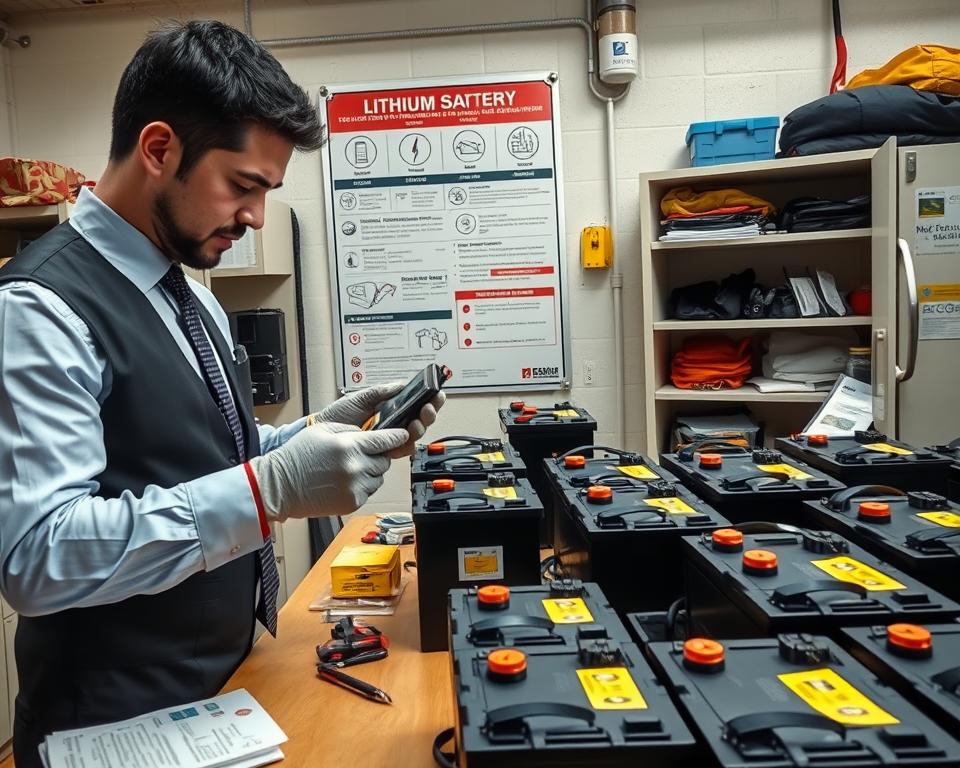
Battery management systems (BMS) are crucial for everyday use and lasting reliability. They keep an eye on battery health, manage temperatures during charging, and protect the battery by shutting things down if something looks wrong. Cloud technology helps companies like Tesla and Ford fix problems before they happen and improve their cars.
Thermal runaway is the biggest risk with lithium batteries. Research is underway to find safer materials that don’t catch fire as easily. Better construction materials and cooling methods also help keep batteries safe during tough conditions.
In the U.S., strict rules guide how batteries must be tested and shipped. They have to meet specific safety and transport regulations. Groups like the EPA and Department of Energy support projects for battery reuse and recycling, but there’s no single rule about it yet.
Various programs at the state and national level encourage recycling and making batteries in the U.S. Bodies like SAE International set testing standards. Makers of cars and batteries use these standards to make sure their products are safe and pass inspections.
Companies are responsible for keeping their battery products safe throughout their entire life. This includes choosing the best battery cells and making sure they meet safety standards. They also offer warranties and updates to make sure safety promises are kept.
Rules from agencies like DOT and EPA oversee battery transport, storage, and disposal. It’s important to throw away batteries in the right way to prevent fires and recover valuable materials. Companies like Redwood Materials show how to do this safely and follow the rules.
The world of battery safety is always changing with new battery types and designs. Solid-state batteries and those with less cobalt could offer safer alternatives. Until then, focusing on strong BMS design, thorough testing, and following safety rules is key to keeping everyone safe.
Materials and Supply Chain: Sourcing, Risks, and Alternatives
The race to build reliable EV batteries relies on specific raw materials and a complex global supply chain. Automakers and battery makers deal with fluctuating prices, concentrated production, and ecological concerns. These factors influence when and how they can produce batteries and choose their suppliers.
Lithium, cobalt, nickel, and graphite are key for battery quality. By 2022, Chinese companies controlled over two-thirds of the world’s cobalt refining and about 72% of lithium refining. The main cobalt mines are in the Democratic Republic of the Congo, which poses a risk to U.S. companies and big names like Tesla and Ford.
From 2020 to 2022, the price of lithium carbonate surged due to high demand. Despite new mines and battery factories in the U.S., we must increase local production quickly. This is essential to reduce reliance on imports. Otherwise, supply disruptions could slow down car production and make prices go up for buyers.
Mining and processing these materials can harm the environment and people. Issues include destroying habitats, using up water, releasing greenhouse gases, and unsafe working conditions in cobalt areas. To address these concerns, places like the European Union, the United States, and Canada are investing in refineries and recycling projects. This effort aims to reduce dependency on uncertain supply chains.
Right now, we don’t recycle lithium batteries much. Unlike lead-acid batteries in the U.S., which are almost fully recycled, only a tiny fraction of lithium-ion cells are reclaimed. By improving recycling for lithium batteries, we can get back important elements like cobalt, nickel, and lithium. This process also reduces the need to mine new materials.
Manufacturers and scientists are exploring new battery types to lessen dependence on rare metals. They’re testing batteries made from sodium-ion, lithium-sulfur, and solid-state substances. There are also efforts to create batteries without cobalt and ones with silicon-enhanced parts. These innovations could increase storage capacity without adding to supply chain pressures.
However, these new battery technologies aren’t ready for big-scale use yet. Ideas based on magnesium and aluminum ions look promising in the lab but aren’t developed enough for the market. Making these alternatives widely available will depend on better recycling methods, ongoing investment, and supportive policies promoting sustainable supply networks.
To make the supply chain better for everyone, policy support, private funds, and technological improvements must come together. This collaboration will help the industry shift from fragile sources to a strong, green supply system. Such a system would support the growth of electric vehicles, taking care of both the environment and people’s needs.
Manufacturing and Scalability: From Cell to Gigafactory
Turning lab-based battery recipes into mass-produced units is complex. It requires blending exact chemical mixtures with advanced automation. This shift impacts the cost, energy consumption, and the location of manufacturing facilities.
Manufacturing steps and cost drivers
Initially, the process includes mixing slurry, coating electrodes, and drying them. The next steps involve cutting electrodes to size, vacuum drying, and putting cells together. Some use a jelly-roll design, while others are stacked. Welding them shut, charging to form, adding electrolyte, and letting them age are final steps.
All these steps make up about 25% of a battery’s total cost. The shape of the cell can impact how it’s made and how much it costs. The price of nickel, cobalt, lithium, and graphite are big factors in the cost. But, better production lines and yields can make each battery cheaper.
Scaling challenges and energy intensity
Growing production size requires a lot of money and skilled workers. Making batteries uses three times more energy than creating parts for gas engines. The high energy use makes operating costs go up. So, using green power sources becomes crucial.
Making the process better can reduce energy use per battery and its environmental impact. Examples include using quicker drying methods, reclaiming solvents, and optimizing cell formation. These improvements help make more batteries while staying eco-friendly.
Industry consolidation and U.S. capacity growth
Big companies like CATL, LG Energy Solution, Panasonic, and SK On lead the market. Car makers and their suppliers are now investing in local plants. This reduces risks and keeps production close. The U.S. and Canada are offering incentives for this shift, including for recycling.
As the market consolidates, smaller companies need to find niches or partner up. Investing in local battery production is vital. It ensures a steady supply of top-notch batteries for American cars and trucks.
Environmental Impact and Disposal: End-of-Life Pathways
The rise of electric vehicles leads to questions about disposing of their batteries. How we handle lithium battery disposal and recycling affects our environment. Choices in policies, designs, and markets influence what gets recycled.
Compared to older battery types, not many lithium batteries get recycled. For example, almost all lead-acid batteries in the U.S. are collected. But global numbers for lithium-ion battery recycling are much lower. The reasons include a lack of standard methods and the risks of taking batteries apart.
Recycling rates and current gaps
Gaps in collection and not knowing where batteries end up limit recycling success. Public efforts try to increase recycling, but consistent rules are rare. Because of this, valuable metals are often thrown away or not handled properly.
Recycling methods and material recovery
Different recycling methods exist. Pyrometallurgy involves melting down cells to get metals like cobalt and nickel. Hydrometallurgy uses chemicals to separate and refine metals. Direct recycling focuses on recovering key battery materials efficiently.
Companies like Tesla and Ford are working on easier to disassemble designs. This reduces the use of rare metals and supports recycling efforts.
Second-life applications
Before being recycled, many EV batteries get a second life in storage projects. They help manage power on the grid, store solar energy, or provide backup power. This spreads out their environmental impact over a longer time.
Reusing batteries this way requires careful testing and following safety rules. It ensures users and their properties are safe.
| End‑of‑Life Pathway | Typical Recovery | Key Benefits | Main Challenges |
|---|---|---|---|
| Direct reuse (second life) | Limited reconditioning, retains much of pack value | Extends service life, delays recycling, lowers lifecycle impacts | Variable health, repackaging costs, regulatory testing |
| Hydrometallurgical recycling | High recovery of lithium, cobalt, nickel | Higher metal yields, lower emissions than smelting | Chemical waste handling, capital‑intensive plants |
| Pyrometallurgical recycling | Good recovery of cobalt and nickel | Proven process, tolerant of mixed feedstocks | Energy intensive, lower lithium recovery |
| Direct cathode recycling | Preserves cathode active material | Lower processing energy, improved economics | Emerging tech, requires material sorting and quality control |
| Landfill / improper disposal | Minimal recovery | None | Fire risk, toxic leachate, regulatory violations |
Better rules for collecting batteries, more funding for recycling, and designing for recyclability are crucial. Adopting these strategies will lessen environmental damage and save metals for future vehicles.
Market Trends and Buyer Guidance: Choosing the Best Lithium Battery for EVs
The EV battery market is always changing. This is because car makers and their suppliers are always finding new ways to improve batteries. When you’re looking to buy one, consider how well it performs, how it fits into the bigger picture, and what it will cost you in the long run.
Start by looking at key performance numbers. These include how much energy the battery can store, how long it lasts, its cost, how quickly it can charge, and how well it can handle temperature changes. Things like battery management systems and the car’s design play a big role in these areas, especially in different weather conditions.
Don’t forget to think about state incentives and the availability of charging stations. Tax breaks and rebates can make a big difference in cost. Being able to quickly charge your battery makes the car more practical for daily use and longer trips.
What to evaluate when comparing EV battery systems
Look for reliable data on energy storage and battery life. Also, check the warranty for how long the battery should last and how it’s protected. Look into how well the battery’s management system works, including safety measures and how it balances power in the cells.
It’s important to consider who is making the battery. Top battery makers like CATL, LG Energy Solution, and Panasonic provide lots of information on how their batteries hold up over time. Buying from these companies can also mean better support and quicker fixes.
Best lithium battery profiles by application
If you’re trying to save money or if the car will be used a lot, consider lithium iron phosphate (LFP) batteries. They last long and work well in most temperatures, making them great for cars that need to be reliable more than fast.
For the cars that need to go far or fast, look at nickel-cobalt-manganese (NCM) and nickel-cobalt-aluminum (NCA) batteries. They store more energy, which means the car can go further on a single charge.
New battery technologies, including solid-state batteries, might change the game. They can store more energy and charge faster. However, they’re not widely available yet.
Manufacturer and model considerations for U.S. buyers
When checking out different car models, pay attention to the warranty and how the battery’s performance might decline. See if the car can use specific charging stations, like Tesla’s, which could be a big plus. The ability to update the car’s software and get proper battery care is also key.
Think about the total cost over time, including how much a new battery might cost and the car’s overall lifetime. Good support from the manufacturer, including updates and check-ups, can lower risks and keep the car’s value up.
| Buyer Priority | Recommended Chemistry | Representative Suppliers | Key Metrics to Check |
|---|---|---|---|
| Durability & Safety | LFP | BYD, Contemporary Amperex (CATL), Tesla (LFP models) | Cycle life, thermal stability, warranty years |
| Maximum Range & Performance | NCM / NCA | Panasonic, LG Energy Solution, Samsung SDI | Energy density (Wh/kg), charge rate, degradation curve |
| Future-proofing | Emergent solid-state / next-gen | Panasonic (R&D), Toyota (development efforts), QuantumScape (research) | Projected Wh/kg, commercial availability, safety validation |
| Fleet cost-efficiency | LFP or optimized NCM | CATL, LG, Panasonic | Cost per kWh, total lifecycle cost, warranty terms |
Summary and Final Assessment
Lithium batteries have changed electric cars for the better. They have made cars go further, last longer, and cost less. The price of these batteries has dropped a lot since 2013. With new advances on the horizon, we can expect even better safety and performance. This makes lithium batteries a top choice for many car makers today.
Now, making batteries safe and following rules is key to success. Strong battery systems and new safety rules in the U.S. and EU make things safer. For buyers in the U.S., it’s important to pick the right battery type. LFP batteries are safe, last long, and are affordable for many cars. NCA/NCM batteries are best for cars that need to go really far on a single charge.
There are big challenges with supply chains and recycling. Issues with mining in the Congo and lithium sources in Chile show we need to find different sources. Also, we need to recycle more to make the industry sustainable. Focusing on better recycling methods is crucial for the future of lithium batteries.
To sum up, lithium batteries are still leading in powering electric vehicles. They are getting more efficient and there are clear plans for new innovations. The companies that focus on making lots of batteries, ethically sourcing materials, and recycling are going to be the leaders as we see new technology developments.