
Anúncios
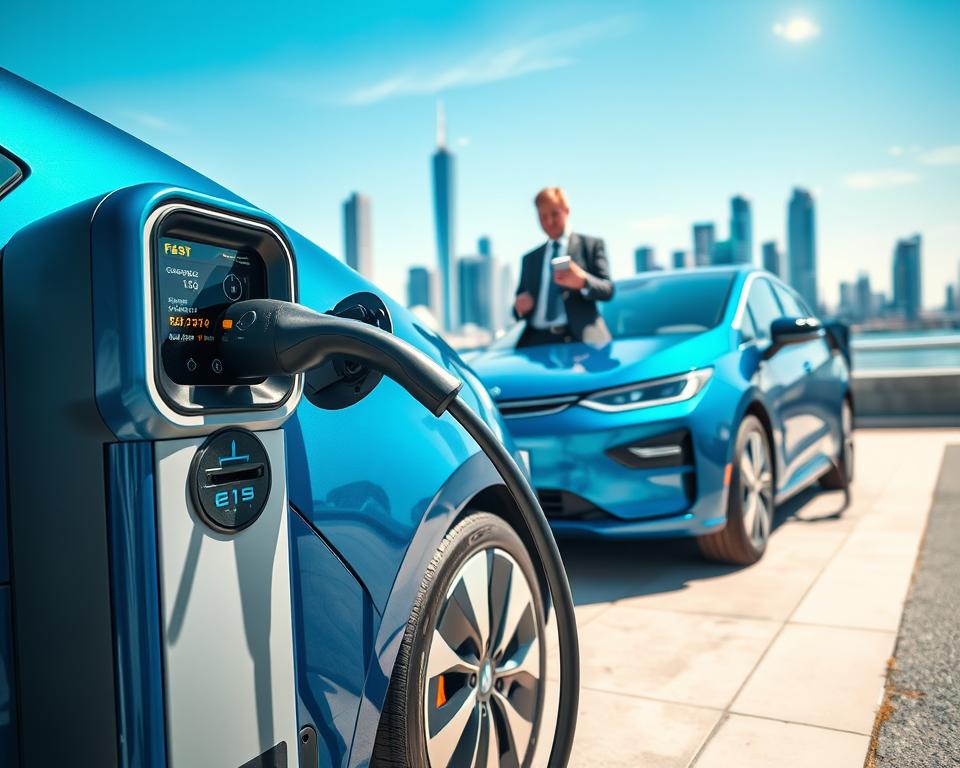
Fast charging slashes the wait that irks many who drive EVs. It’s for travel, commuting, and managing fleets.
Quick charge spots and powerful DC stations give range quickly. This reshapes how trips and stops are planned in America.
Rapid charging tech uses data about the battery’s charge. It also applies smart tech to save energy and protect the battery.
Speedy charging, mixed with solar power and grid control, reduces wait times. It also helps avoid high demand and saves on costs.
The state of charge (SOC) shows how charged a battery is. It often indicates the time to reach 80% charge.
EVs reduce charging speed when nearly full to save the battery. So, planning usually involves stopping to charge to 80%.
The charging time can change based on the charger’s power, the battery size, and the weather. Extreme temperatures can make charging take longer.
Public rapid and ultra-rapid DC chargers range from 50 kW to 350 kW. They’re meant for quick stops on long trips.
Smart charging linked with solar power can reschedule charging times. It reduces costs and eases the strain on the grid during busy times.
Understanding the Concept: Old Way vs New Way of Charging
Before, electric vehicle (EV) owners would charge their cars like they do laundry: plug in before bed and forget about it. Using home chargers or basic plugs, cars get 3kW–7kW power. This is okay for overnight charging but not for a quick midday boost.
Public AC chargers also have limits because of the car’s own charging capacity. Many cars can only take in 6.6kW–7kW, making charging stops long. For those needing quick charges, the old method doesn’t work well.
DC fast charging is the new way to go. Rapid charging stations offer power from 50kW to 350kW. A 50kW station can get most cars 80% charged in under an hour. And ultra-rapid chargers can do it in about 30 minutes for EVs that can handle it.
Battery chemistry plays a big role in how an EV charges. Most can quickly charge up to 80% before slowing down. This is to keep the battery healthy for a long time. Fast chargers are great for quick top-ups because of this.
Rapid charging is more efficient with system-level tools. These include smart scheduling and solar power, which reduce costs. Fleet managers also use these tools to make sure chargers are ready when needed.
For charging to be quick in real life, managing the battery’s temperature is key. Pre-heating the battery helps in cold weather. Brands like Tesla, Ford, and Hyundai have systems to keep charging speeds up.
Here’s a brief look at the main differences between the old and new charging methods.
| Aspect | Old Way (AC/Home) | New Way (DC Fast / Rapid) |
|---|---|---|
| Typical power | 3kW–7kW (3-pin or dedicated home charger) | 50kW–350kW (public DC fast and ultra-fast) |
| Practical use | Overnight top-ups, low-cost home energy | Short stops, long trips, quick charge sessions |
| Onboard limits | Often limited to 6.6kW–7kW charging rate | Bypasses onboard AC limits; uses vehicle DC acceptance rate |
| Charging curve | Slow, steady fill over hours | Fast bulk to ~80% then taper to protect battery |
| Grid and cost tools | Simple scheduling, lower infrastructure needs | Smart charging, load management, solar integration |
| Real-world time to ~80% SOC | Several hours overnight | Under 60 minutes at 50kW; ~30 minutes at 150kW+ on supporting EVs |
Workflow: How Fast Charging Works for EV Owners
First, use apps like PlugShare, ChargeMap, or Zap-Map to find a good charging station. Look for ones with 50 kW–350 kW DC fast chargers that fit your car’s needs. Make sure the station supports CCS or CHAdeMO if your vehicle needs it.
Next, park and plug in the charger. You can use the cable at the station or your car’s connector. Then, you start the charge with an app, an RFID card, or at the kiosk. Many stations will tell you how full your battery is and how long until it’s 80% charged.
The charger will quickly power up your car at the highest speed it can handle. This fast bulk charging phase is key for a quick boost. It’s the best thing about high-speed charging for quick stops.
When the battery hits about 80% full, it starts charging slower to keep the battery safe. This makes charging the last 20% take longer. That’s why many drivers stop charging at 80% for the fastest overall charging time.
To finish, you just end the charging session on the app or kiosk. Then unplug and you’re ready to go. Some advanced chargers can work with your home to plan your next charge. They help save money and keep charging efficient.
| Step | Action | Why It Matters |
|---|---|---|
| Locate | Use PlugShare, ChargeMap, or Zap-Map to find 50–350 kW stations | Ensures access to true fast charging and high-speed charging equipment |
| Initiate | Park, connect CCS/CHAdeMO, start session via app or RFID | Starts billing and displays SOC so users can plan quick stops |
| Bulk charge | Charger supplies peak DC power until ~80% SOC | Maximizes energy transfer rate, enabling turbo charging benefits |
| Taper | Battery management reduces power past ~80% SOC | Protects battery health while lengthening final charge time |
| End session | Stop session, disconnect, depart; use smart scheduling for next charge | Maintains efficient charging routines and can lower operating cost |
Key Options: Comparison of Fast Charger Types and Products
Choosing the right fast charger means looking at how you’ll use it, your vehicle’s limits, and power in your area. Fleet managers and EV owners should think about station power and if they need AC or DC charging. They should also match their vehicle’s max power intake with the station. This way, they won’t pay extra for power they can’t use.
For short trips or shopping, 50kW DC chargers are great. They can charge most cars to about 80% in an hour. For longer trips, 150kW DC chargers are better. They can greatly reduce charging time for vehicles that can handle it. The most powerful 350kW stations can charge some cars to 80% extremely fast. But, not all cars can use these chargers.
For home or small fleets, AC charging is common. A 7kW wallbox is good for overnight charging. A 22kW charger can fill a battery faster if you have the right power supply. Smart chargers can use solar power or charge when it’s cheapest. This saves money and charges faster when power costs less.
When looking at chargers, consider how fast they charge, their cooling systems, and cable types. Also think about costs to set them up. The charge rate a car can handle and how it manages heat are important. The local power grid and available setup also affect if ultra-fast charging is a good choice for you.
| Name | Role | Main Benefit |
|---|---|---|
| 50kW DC Fast Charger | Rapid public charging | Reliable 80% SOC in ~60 minutes for many EVs — good for highway stops and shopping trips |
| 150kW DC Ultra-Rapid Charger | Long-distance fast top-ups | Much faster bulk charging (30–40 minutes to 80% on supporting vehicles) |
| 350kW High-Power Charger | Next-gen ultra-fast stations | Potential to reduce 80% SOC times to ~15–30 minutes for compatible EVs |
| 7kW Home Wallbox (AC) | Overnight charging at home | Convenient, cost-effective overnight fills — typically 8–10 hours for many EVs |
| 22kW Three-Phase AC Charger | Faster AC charging where available | Reduces AC charge times to 3–4 hours for compatible EVs but requires three-phase supply |
| Smart Charger with Solar Integration | Home or commercial smart charging | Optimises charging times and cost by using solar or off-peak electricity |
Choosing between a quick charger and an ultra-fast charger needs careful thought. Think about the cost, how much you’ll use it, and if your vehicle can handle it. Look into incentives, peak charges, and how often you’ll need a rapid charge.
Efficiency of Fast Charging: Advantages Supported by Data
Fast charging minimizes wait time by quickly powering up vehicles. Studies from public networks and car makers reveal how fast charging saves time when the station and vehicle’s power levels match. You’ll see details on how long it takes to charge, limits from the car’s technology, how cold affects charging, and how fast charging impacts battery life.
Bulk-charge speed and typical times
Common fast chargers, around 50 kW, get many EVs to 80% charge in near 60 minutes. Stations with 150 kW power can reduce this to about 30–40 minutes for compatible vehicles. The fastest chargers, at 350 kW, shorten the time to 15–30 minutes for certain cars like those from Tesla, Hyundai, and Porsche.
Impact of battery size and onboard limits
Bigger batteries take longer to charge because they need more energy. Charging a 100 kWh battery takes more time than a 40 kWh one at the same power setting. The maximum charging speed a car can handle is also limited by its design.
A 6.6 kW AC limit on a Nissan Leaf means it can’t charge faster at a 22 kW AC station. Also, if a car’s design limits its DC charging speed, even powerful stations won’t speed things up.
Effect of temperature and pre-conditioning
Cold temperatures make it harder for batteries to charge, slowing down the process. When it’s -7°C to -1°C, charging can take 20–30% longer, based on tests and what manufacturers say.
Warming or cooling batteries before charging can help. This process, called pre-conditioning, makes it possible to charge faster even in very cold or hot weather.
Charging behaviour and battery health trade-offs
Car makers slow down charging after 80% to keep the battery healthy. That’s why many drivers stop charging at 80%. If your car has a good cooling system, using fast charging a lot can still be okay. Still, it’s best not to do it all the time to make your battery last longer.
Fast charging is great for quickly boosting your battery, especially at the beginning. How well it works depends on your car, the battery size, how full it is when you start, and the weather. Planning to charge up to 80% and warming up your battery first helps you charge fast and keep your battery healthy.
Product Performance Review: Fast Chargers on the Market
This review looks at different chargers, how they work with various cars, and their reliability. It’s important for people like fleet managers, car dealers, and everyday drivers to know what to expect. Here are some key points from real use and official data.
Real-world charging times by charger class
50 kW DC chargers usually get most EVs to 80% in about an hour. This is common for cars like the Nissan Leaf and Chevrolet Bolt.
At 150 kW charging stations, the time drops to 30–40 minutes for 80%. This is seen in the Tesla Model 3 Long Range and Ford Mustang Mach-E, with the right charger.
For the fastest charge, 350 kW chargers work best with certain cars. This includes the Porsche Taycan and others designed for quick charging. They reach 80% faster than others.
Compatibility and interoperability
In the US, CCS is the main DC charging standard. CHAdeMO is becoming less common. Not every EV can handle the fastest chargers.
Software updates can help cars and chargers work better together. Sometimes, charging stations share power between cars, which can reduce charging speed when it’s busy.
User experience and station reliability
The condition of the charger and how reliable it is can affect your charging experience. A high-power charger that often breaks is not as good as a reliable 150 kW one.
Apps like PlugShare and ChargePoint help drivers find working stations. For businesses, choosing a vendor with good support and warranties is key.
| Charger Class | Typical Time to 80% | Best Suited Vehicles | Notes on Performance |
|---|---|---|---|
| 50 kW | ~60 minutes | Compact EVs (Bolt, Leaf) | Consistent across many mainstream models |
| 150 kW | 30–40 minutes | Mid-range and many crossovers (Model 3 LR, Mach-E) | Good balance of speed and network availability |
| 350 kW | 15–30 minutes | High-power-capable EVs (Taycan, Ioniq 5/6, Lucid) | Peak performance only with compatible vehicles and full site power |
When evaluating hardware, prioritize vehicle DC acceptance, network uptime statistics, and how power is distributed at multi-stall sites.
Cost Considerations: Pricing, ROI, and Operating Expenses
Before setting up chargers, it’s key to plan your budget. Installing a home wallbox, like a 7 kW unit, involves several costs. These might include paying an electrician, adding new circuits, and even upgrading your panel. You might spend a few hundred to a few thousand dollars, based on the work’s complexity and local fees.
For business locations, the costs go up. Setting up a 50 kW fast charger requires concrete work and digging trenches, plus dealing with the utility company. If you want bigger chargers, from 150 kW to 350 kW, the expenses can hit tens or hundreds of thousands. This includes needing new transformers and improving the site’s power. Early planning with your utility company can help avoid unexpected costs and speed up the process.
Per-session pricing changes depending on where you are and the network. Some places charge by the kWh, others by minute, or a flat rate for each session. Charging by kWh is easy for drivers to understand and matches many states’ electricity costs. Charging by the minute can encourage faster charging. However, it might be unfair to slower charging cars when the speed decreases.
Charging station owners need to keep track of the cost per kWh. Public fast charging often costs more than home charging during off-peak times. This is because of higher demand and infrastructure costs. Having clear signs and app-based pricing can help avoid arguments about charges.
There are also ongoing costs like maintenance, network fees, and special electricity rates for high usage. Demand charges can be the biggest expense for places with powerful chargers. Using tech like smart charging and battery storage can help manage these costs by spreading out energy use.
How quickly you get back your investment depends on where you put the chargers and how much they’re used. Places with a lot of people, like rest stops or shopping centers, tend to bring in more money. Fleet operators also find value in chargers that help keep their vehicles running smoothly.
Federal and state support can also help lower the starting costs. There are many programs, like tax breaks and rebates, that can reduce initial expenses. Using these benefits, along with smart pricing and charging practices, can make your investment pay off sooner.
To figure out your potential return, it’s smart to be cautious in your predictions. Include expected maintenance costs and think about electricity prices in the future. Partnering with companies or using software to schedule charging can also help you earn more from each charging spot.
Owners should also consider different outcomes based on usage, charging fees, and power costs. By focusing on efficient charging and thoughtful location choice, you can better understand the financials. This approach helps in reducing costs and achieving a faster return on your investment.
Practical Tips to Reduce Wait Time While Fast Charging
Short trips and long hauls both gain from habits that cut down charging time. By planning routes, looking after your battery, and choosing chargers wisely, you can shorten charging breaks. These tips are great for anyone driving daily or managing a fleet looking for fast charging solutions.
Target 80% SOC for routine stops
Charging speed slows down after reaching about 80% battery charge. Stopping at 80% at public chargers balances the energy you get versus the time spent. Aim for this during long trips to skip the slow charge times at the end.
Use apps and pre-planning
Apps like PlugShare, ChargePoint, and ChargeMap help you find chargers and see if they are available. Plan to use fast chargers between 50 kW and 350 kW to avoid waits. Checking chargers ahead helps you stop where you can charge quickly, avoiding surprises.
Pre-condition and manage battery temperature
Cars from brands like Tesla, Ford, and Hyundai can warm up or cool down their battery beforehand. This makes charging faster, especially in very cold or hot weather. It helps a lot with fast charging when the temperature outside is extreme.
Choose compatible high-power chargers when possible
Use chargers that match your car’s charging speed. If your EV can handle 150 kW or more, use those chargers to get the most energy possible. If your car charges slower, look for stations that are more reliable or cheaper. This optimizes your charging experience, especially during fast charging stops.
For managing fleets, plan charging times to avoid all cars charging at once. Use smart charging to avoid high costs and keep chargers available. Combining home charging with cheap electricity rates means less reliance on public fast chargers. This method saves time and money during crucial charging needs.
Regulatory and Infrastructure Trends in the United States
The U.S. is building more public chargers quickly, thanks to federal and state help. Money from the National Electric Vehicle Infrastructure program and state offers lower the costs for those hosting chargers. This effort makes fast charging common in more areas, including places that had few before.
Government funding and build-out initiatives
The government helps pay for fast chargers on highways and in cities. States also give rebates and help with permits to make things faster. This way, businesses can afford to add chargers now and plan to increase their power later.
Grid impacts and smart charging solutions
High-power charging stations can make electricity use spike, leading to extra fees. To handle this, utilities are trying out new pricing, managing when electricity is used, and testing technology that lets cars give power back to the grid. Adding solar panels and batteries can also help by using less electricity from the grid.
Standards and interoperability
In the U.S., CCS is the main way to plug in electric cars, and making chargers work together is getting better. It’s important to keep standards, payment systems, and software up to date so charging is easy for everyone, no matter the car or charger brand.
Summary and Final Assessment of Fast Charging Solutions
Fast charging reduces waiting time for electric vehicle drivers. Charging stations that offer 50 kW to 350 kW can charge up to about 80% in minutes. The speed of charging can change depending on the car model and other factors.
For most U.S. drivers, using a 7 kW charger at home and 50 kW–150 kW public chargers for trips is ideal. This method is both affordable and convenient. For cars that can handle it, ultra-rapid 350 kW stations are also available.
To keep costs low and charging efficient, it’s good to choose the most suitable charger. Picking the right charger can save money and help the environment.
To get the most out of charging, aim for 80% battery. Use smartphone apps to find the best charging spots. In cold weather, warm up your battery before charging. Using smart charging or solar power can cut costs and help the planet.
To sum up, fast charging effectively cuts down wait times for EV owners. It works best when the car’s capabilities, charging stations, and smart energy use all work together. When done right, fast charging is a reliable way to save time.