
Anúncios
The regenerative braking system turns moving energy into stored electricity. It uses the motor as a generator.
This technology cuts down on wear on brakes and adds electricity back to the battery. It makes things last longer.
Hybrid and electric cars use automotive regenerative braking. It fits best with cars that have electric systems.
Regeneration works with regular brakes for safe stops. It ensures the brake pedal feels right, no matter the situation.
Anúncios
Regenerative braking grabs energy when a car slows down or goes downhill. It helps cars run more efficiently in city traffic.
Big car makers like General Motors and Ford mix systems for better regenerative braking. They make one-pedal driving possible.
The energy saved varies a lot—Ford says you can get back about 10%–30% energy. It depends on how and where you drive.
Regenerative braking also lowers how much you spend on maintenance. It reduces the need for parts that usually wear out.
Understanding the concept: Old way vs New way
Anúncios
Stopping a car the old way uses friction. Brake pads squeeze against rotors, changing moving energy into heat. This heat escapes into the air, not helping the car later. Regular stops in the city wear out these parts fast, making maintenance expensive.
The new method involves the traction motor acting as a generator. When slowing down, this motor turns the moving energy into electric energy. It then stores this energy in the battery or another device like a flywheel, showing the basics of regenerative braking.
Regenerative braking holds several benefits. It can make electric cars go further, use less fuel in hybrids, and reduces wear on brakes. Less need for mechanical braking means pads and rotors last longer and cost less over time.
Today’s vehicles mix both systems for safety and stable pedal feel. General Motors uses software to smoothly switch between regenerative and traditional braking. GM also has features like Regen-on-Demand paddles and One-Pedal Driving to increase energy recovery.
Ford highlights that plug-in hybrids grab more energy back since they rely more on electric power in city drives. These regenerative systems work alongside traditional brakes. This ensures drivers feel a smooth slow down and trusty stopping force.
Here’s a quick comparison showing key differences between both methods and what fleet managers and buyers need to think about.
| Aspect | Traditional Friction Braking | Regenerative Braking |
|---|---|---|
| Energy fate | Kinetic energy → heat (wasted) | Kinetic energy → electrical/mechanical storage (recovered) |
| Component wear | High pad and rotor wear in urban driving | Reduced mechanical braking demand; longer pad life |
| Impact on range | No effect on propulsion range | Can extend EV range and reduce fuel use in hybrids |
| System complexity | Simple mechanical design | Requires electrified architecture and software blending |
| User control | Conventional brake pedal feel only | Modes like One-Pedal Driving and Regen-on-Demand increase recovery |
| Best use case | All vehicles; simple retrofits limited | Hybrid and electric vehicles, urban and stop-and-go routes |
How regenerative braking works
Regenerative braking changes a vehicle’s speed into stored power when the driver slows down or stops. This process makes the traction motor act like a generator. It turns the wheels’ movement into electrical energy to recharge the battery or power up other systems.
Big car companies like General Motors and Ford mix this tech with regular brakes. The car’s computer looks at speed, the driver’s actions, the battery’s charge, and temperature. It then figures out how much power the motor can generate before using the regular brakes.
This kind of braking works best at high speeds because there’s more motion energy. But at slow speeds, regular brakes are still needed for safe stops and parking. Hybrid cars benefit more from this because they use electricity more often.
Some cars let drivers control how much energy they want to regain and even stop using just the motor. This saves energy and reduces wear on the brakes. If the battery is full or hot, the car switches back to normal brakes to stay safe.
The system that mixes regenerative and traditional braking ensures the brake pedal feels the same all the time. New tech uses electronic controls to meet this goal while getting back as much energy as possible, whether you’re in the city or on the highway.
Key options: comparison of regenerative braking system choices
The market offers different regenerative braking systems. Each has its own pros and cons regarding cost, complexity, and how well it performs. Battery-based regen stores energy in the traction battery. This is good for passenger electric vehicles and hybrids like those from General Motors and Ford. These use software to manage charging limits and keep the battery at the right temperature.
Supercapacitor-assisted regen uses capacitors for quick energy storage and release. Mazda’s i-ELOOP is an example. This system is great for quick, repeated braking. It also puts less strain on the main battery.
Flywheel and KERS solutions store energy in a mechanical way. Racing teams and some special manufacturers prefer KERS for its powerful energy bursts and longevity. These systems are designed more for performance than regular passenger cars.
Rheostatic braking is key when other storage options aren’t available. Here, resistors turn extra energy into heat. Rail operators use rheostatic braking as a plan B. It helps during high demand or when onboard storage can’t take more energy.
Grid-fed regeneration sends the recovered energy back to the power supply or local grid. For example, urban rail systems used by Caltrain and British Rail can power nearby trains or substations. This method improves efficiency across the network when the right infrastructure is in place.
| Option | Best use | Key advantage | Typical limitation |
|---|---|---|---|
| battery-based regen | Passenger EVs, hybrids | High energy density, integrates with vehicle controls | Battery acceptance limits, thermal management |
| supercapacitor-assisted regen | Stop-start urban routes, frequent braking | Rapid charge/discharge, long cycle life | Lower energy density than batteries |
| KERS (flywheel) | Motorsport, performance vehicles | Very high power output, durable cycles | Packaging complexity, niche applications |
| rheostatic braking | Fallback on rail and heavy vehicles | Simple, reliable dissipation of excess energy | Energy lost as heat, lower efficiency |
| grid-fed regeneration | Electrified rail networks | Network-level energy reuse, reduced onboard storage needs | Requires compatible infrastructure and controls |
Manufacturers mix and match these systems to fit different vehicles. GM fine-tunes its battery-based regen with special driver controls. These include Regen-on-Demand paddles and one-pedal driving modes. Ford uses KERS for its performance vehicles but opts for hybrid regen strategies in production models.
Choosing the right system involves looking at many factors. Consider the vehicle’s duty cycle, how sensitive it is to weight, and the available infrastructure. Fleet buyers must balance the need for quick energy recovery with storage capacity and maintenance. Rail operators should think about grid-fed regeneration when their substations and power systems allow it.
Regenerative braking in electric vehicles
Regenerative braking in electric vehicles turns moving energy into battery power while the car slows down. It connects motor-generators to the drivetrain, making braking a way to charge up. The system combines regen and regular brakes for smooth stops and maximum safety.
Integration with EV drivetrains
EVs have motor-generators in the transmission or axle to collect energy. A control system blends motor torque with hydraulic brakes. On slight slopes, some cars can stay put using regen, but regular brakes are needed for full stops.
One-Pedal Driving and user controls
Drivers can choose how much the car slows when lifting off the pedal. One-Pedal Driving makes city trips easier by using just the accelerator. For more energy recovery and control on downhills, some cars have special buttons or paddles.
Real-world product examples
GM uses regen that works even when braking normally. The Chevrolet Bolt and other models include One-Pedal Driving and handy paddles. They ensure smooth braking and assist with automatic driving in hilly areas.
Ford’s regen is in hybrids like the Escape Plug-In Hybrid. They recover 10% to 30% of energy in the city, improving fuel use and reducing brake wear. Mazda’s i-ELOOP and systems in big trains that send energy back to the power grid are other examples.
Regenerative braking efficiency and performance data
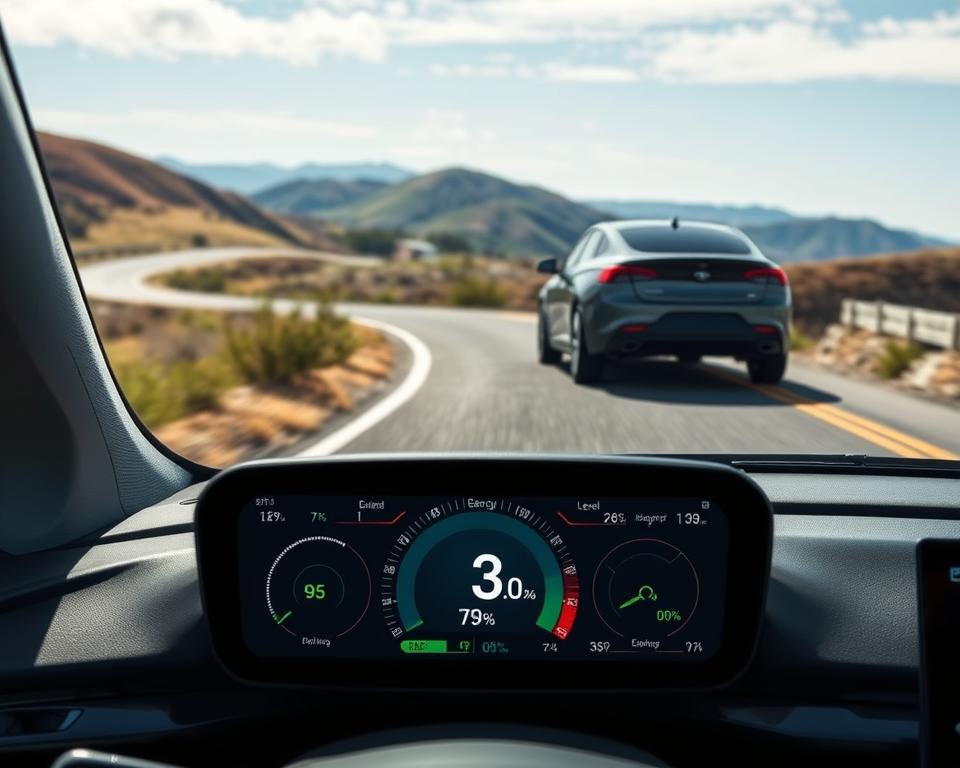
Real-world data and lab results show how effective regenerative braking is. This includes buses, trains, and cars. They all differ in how much energy they can get back. This info helps experts plan better for energy savings and how it affects fleets.
Energy recovery percentages
Rail systems often get back 15% to 25% of the energy they use. The London Underground’s newer trains can save around 20% of their energy. Caltrain’s modern trains give back about 23% to the power grid. British Rail’s fast trains have a 17% energy saving. City trains like in Delhi can save a lot of energy, helping the city.
Fleet and city impacts
The impact on fleets depends on the city and how the vehicles are used. In cities, buses and electric vehicles do better in saving energy. Ford says their hybrid cars save between 10% and 30% of energy. This also means buses and cars need less maintenance thanks to regenerative braking.
Vehicle-level range improvement
On a single vehicle basis, regenerative braking can increase how far you can go. General Motors explains how their cars gain extra range from this technology. But, the amount of energy saved changes based on the battery and driving conditions. For plug-in hybrids, it means more miles without using gas.
However, there are limits to how much energy can be saved. Regenerative braking isn’t as good at low speeds or with almost full batteries. Sometimes, other braking methods are used instead. Designers work hard to find the right balance for the best energy savings and safe braking.
Advantages of regenerative braking
Regenerative braking offers real-world benefits to drivers, fleets, and transit groups. It turns movement energy into extra power, helping cars from General Motors to Ford go further per charge and use less fuel. This leads to clear cost savings in daily use and in heavy traffic.
Range and efficiency benefits
Recapturing energy makes vehicles more efficient and boosts their electric range. In cities, this saved energy means plug-in hybrids and EVs can drive more on electric power alone. Plus, drivers can adjust regen settings to save even more power or maintain a normal braking feel, even when the battery is full.
Maintenance and cost benefits
Slowing down with the motor means less wear on traditional brakes. With reduced wear, brake pads and rotors need changing less often, saving money on repairs. Fleet managers appreciate the lower costs and less downtime, ensuring braking systems last longer with fewer replacements needed.
Environmental benefits
Reusing energy lowers the need for fuel and electricity, reducing greenhouse gases. Some rail systems even give power back to the grid, cutting energy use and emissions overall. Transit groups and car makers see notable drops in CO2 when regenerative braking is used in busy traffic.
Limitations and safety considerations of regenerative braking
Regenerative braking is efficient but has limits to watch out for. Users need to know how it acts differently based on speed, battery life, and laws. It’s crucial to ensure friction brakes work well as a backup for safety.
At low speeds, you get less energy back, and the brake feeling changes. Electric motors slow the car well at medium speeds, but not as much when slow. So, the car can’t stop with regen alone at very slow speeds.
Blending brakes make the pedal feel smooth and predictable. This means combining electric and hydraulic brakes well. If not done right, it can lead to jerky stops or late brake lights. This is risky.
The battery’s condition affects regenerative braking. If it’s too hot, cold, or full, the car might not use regen. Instead, it uses other ways to brake safely.
Companies like General Motors and Ford have plans for when the battery can’t take more energy. They aim for safe and predictable braking. Teaching drivers about these features helps them know what to expect.
Rules about when to turn on brake lights have changed. Before, cars didn’t always signal braking to others. Now, lights must come on at certain slowing speeds. This helps keep everyone safer and encourages the use of regenerative braking.
Here’s a quick look at the main issues, why they happen, and what automakers do about them.
| Constraint | Primary Cause | Typical Response |
|---|---|---|
| Low-speed energy recovery | Motor efficiency and low kinetic energy at slow speeds | Switch to friction brakes; limited regen below ~5 mph |
| Battery state-of-charge limits | Full pack cannot accept additional current | Reduce regen power; use dynamic braking or friction |
| Thermal battery constraints | High or low cell temperatures reduce acceptance rate | Thermal management and temporary regen cutoff |
| Brake blending performance | Control software tuning and actuator response | Refined pedal mapping and redundant sensors for smooth blend |
| Signaling and illumination | Regen decel not always trigger brake lamps | Software standards to illuminate lights above set decel |
Regenerative braking versus traditional braking
Regenerative systems capture the car’s moving energy and turn it back into electricity. This electricity goes right back into the battery. Friction brakes, on the other hand, turn this moving energy into heat. This process wears down the brakes over time. So, regenerative braking is a great choice for those looking for better efficiency and fewer trips to the mechanic.
Performance comparison
When driving in the city where you stop a lot, regenerative braking can save a lot of energy. Studies by Ford and General Motors found that hybrids and plug-in hybrids get the most benefits. This is because they use their electric engines a lot. But when you slow down to under about 10–15 mph, the amount of energy you can save drops a lot.
Operational trade-offs
To use regenerative braking, a car needs to be set up for it. It also needs smart tech to work well with regular brakes. For example, GM made a system that feels normal to use but still saves energy. However, drivers noticed it feels different when the car slows down, which might take some getting used to. Also, if the battery is full or not the right temperature, the car might have to switch back to regular brakes. This can be unpredictable unless the car’s software handles the switch smoothly.
Use-case suitability
Regenerative braking is super useful for city driving and going down hills. It saves energy and makes brake pads last longer. But for really fast driving on highways or in emergencies, you still need regular brakes. They’re the best choice for stopping quickly and safely.
Ford and Chevrolet have come up with different ways to use regenerative braking. They create settings that allow drivers to choose how much energy they want to save. There’s also a blended mode. It makes the braking feel more normal for those who care more about the driving experience than saving energy.
| Scenario | Regenerative Strength | Traditional Brake Role |
|---|---|---|
| Urban stop-and-go | High recovery, lower pad wear | Backup at very low speeds |
| Hilly terrain | Effective on descents, extended range | Supplement for fade control |
| Highway deceleration | Limited recovery, marginal benefit | Primary for rapid stops |
| Emergency braking | Minimal due to system limits | Critical for safety |
Product review considerations when choosing vehicles with regenerative braking
When looking at a vehicle, pay attention to how it blends regenerative and friction braking. See if features like One-Pedal Driving or Regen-on-Demand are available. It’s also key to check if the system can hold the car steady on a hill and if brake lights come on during regen slowing. These details really matter for daily use and how the car feels.
Look up info from Ford, General Motors, Tesla, and others about how much energy their systems can save. Match what the manufacturers say with real-life regen data from actual driving. Understand how the battery’s condition, temperature, and being fully charged impact regen.
Check out what’s said about brakes lasting longer and needing less maintenance. Make sure the usual brakes still work well in every situation. Talk to dealers about how often the brakes need checking and if service centers know how to handle these combined braking systems.
Try out the car’s controls for choosing modes, how quick the paddles respond, and how regen works with driving help like adaptive cruise control or lane-keeping. Seamless switching between electric and regular braking is important for a smooth drive and safety. Well-designed controls make adjusting regen easy, avoiding any unexpected force or sudden stops.
Ask for test drives in busy traffic and on hills to see if the car goes further on a charge. Test different cars on a city route to compare how much energy they get back. Use what you see to check if what companies claim matches up to actual benefits.
Last, look at how clear and safe the system is. Make sure there are alerts, brake checks, and easy-to-read dash info. A system that’s easy to understand makes drivers more comfortable using regen braking every day.
Installation, retrofit, and aftermarket options
Adding regenerative systems to vehicles with internal combustion engines is tough. These retrofit projects need motor-generators, power electronics, and energy storage. They also need to fit into the vehicle’s electrical system. Rail and commercial vehicles might easily use returned energy. But, passenger cars are harder to convert.
Retrofit feasibility
The chance of retrofitting depends on the vehicle’s wiring, space for equipment, and software access. Many cars from brands like Ford, General Motors, and Toyota have complex control systems. These systems often require changes at the manufacturer level. So, making regenerative braking work in most cars is hard and usually not worth the cost.
Aftermarket energy recovery systems
There are some special options for energy recovery, like flywheel KERS, supercapacitors, and differential systems. Ford and others have tried these in racing and commercial prototypes. Mazda has its i-ELOOP for adding an energy buffer. But these are not one-size-fits-all solutions. They usually only work for specific models.
Maintenance and service implications
Adding new regen tech means more maintenance work. This includes caring for power electronics, high-voltage wiring, and storage systems. Skilled EV technicians are needed. While regenerative braking can reduce brake wear, troubleshooting problems gets trickier. For safe installations, especially those involving control software, dealers and certified service centers are best.
Summary and final assessment
Regenerative braking is a smart tech used in trains and cars to convert movement into electricity. Brands like General Motors and Ford have made systems that make electric vehicles go further, reduce brake wear, and power the vehicle or battery. Generally, it can save between 10% to 30% energy depending on how and where you drive.
When added correctly, regenerative braking is great for U.S. customers. It brings better efficiency, saves money on upkeep, and cuts down emissions. These systems mix regenerative with usual braking safely, especially at low speeds. Also, the car’s software controls it based on the battery’s condition and temperature.
Regenerative braking works best in cities and hilly areas, especially for plug-in hybrids that slow down a lot. Look for systems that mix smoothly, offer settings like One-Pedal Driving, and share clear efficiency numbers. With the right maintenance and teaching drivers how it works, this tech supports the move to electric cars. It also ensures cars can still stop quickly using traditional brakes.